

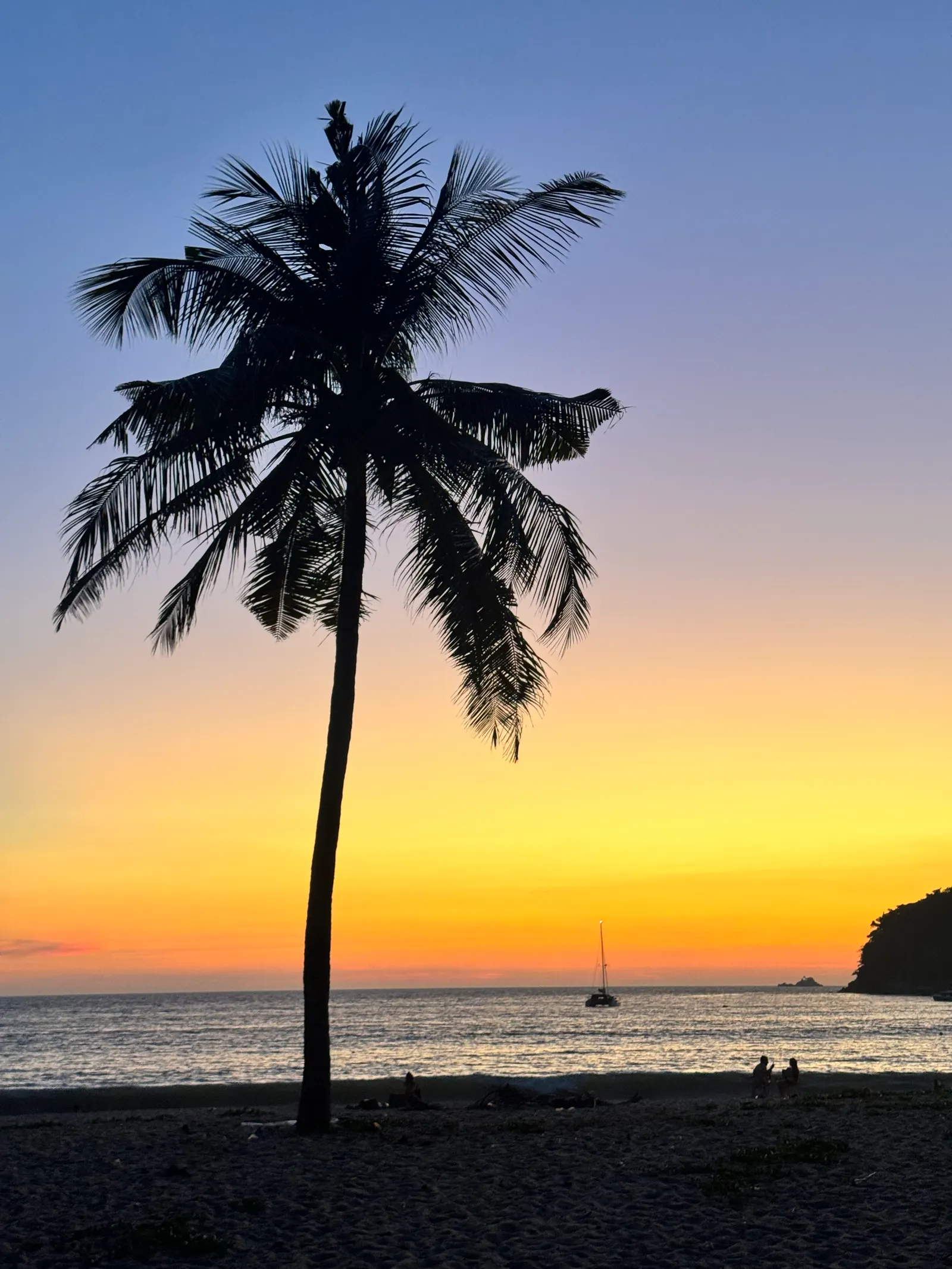
The quiet end of Bang Tao bay: national-park beach, hillside villas and no strip.
- Best for
- quiet · luxury · long-stay · families
- Nearest hospital
- Bangkok Hospital Phuket, about 35 min; Thalang Hospital (public) 15 min
- International schools nearby
- UWC Thailand (Thalang, 15–20 min) · HeadStart International School Cherngtalay campus (15 min)
The lie of the land
Layan is the northern tip of Bang Tao bay, where the beach narrows against a headland, a small river meets the sea and the southern edge of Sirinat National Park begins. There is no town. There is a beach with a few restaurants under the trees, a road that runs behind it to a handful of hotels and villa estates, and hills on both sides where most of the district's houses look down over the bay. Koh Kala, a small island just off the beach, can be reached on foot at low tide.
It suits people who came to Phuket for the sea and the quiet rather than for anything else: couples, families with a car, long-stayers who want a hillside villa with the whole bay in front of them. It has become the address for a particular kind of buyer and renter in the last decade, and the villa and low-rise developments on its slopes reflect that. It is not for anyone who wants to walk to a bar or a supermarket.
Beach and sea
Layan Beach is the calmest stretch of the whole bay. The headland shelters it from the north-west, the sand is fine and the gradient is gentle, and in high season the water is glassy in the mornings. The river mouth at the northern end is shallow enough for children, and the walk across to Koh Kala at low tide is a small adventure. Loungers are few because the beach is inside the national-park boundary; bring your own shade.
The wet season brings smaller waves here than anywhere else on the west coast, and Layan is often swimmable when Surin and Kata are flagged. That said, rips run off the headland on rough days and the beach is not lifeguarded to the same standard as the resort beaches. Jellyfish drift in after storms.
Where to stay
Layan has few hotels and all of them are at the top of the market: Anantara Layan Phuket Resort sits on its own cove at the northern end, and Dream Phuket Hotel & Spa is on the hillside above the road. Beyond those, the accommodation is villas, either in the estates on the slopes behind the beach and along the Layan–Nai Thon road, or standalone houses on the hills with sea views.
Condominiums have arrived on the hillsides in the last few years; low-rise projects such as Layan Verde, on the slope above the beach road, are the district's first real apartment supply and are aimed at owners and seasonal renters rather than at package tourists. There are no hostels and almost no three-star hotels; the nearest budget beds are in Bang Tao and Cherngtalay.
Eating out
The beach has a small row of Thai restaurants under the casuarinas that grill fish and serve the standard menu with sand underfoot, and these are the extent of Layan's dining. Everything else is a short drive: the seafood shacks at the northern end of Bang Tao beach are five minutes south, Boat Avenue and Porto de Phuket ten minutes, and Nai Thon's restaurant row ten minutes north over the hill.
Cherngtalay village, fifteen minutes away, has a fresh market and local kitchens. Residents shop at the supermarkets on Srisoonthorn Road and eat at home more than anywhere else on the coast; a villa here is a villa with a kitchen for a reason.
Getting around
Layan is fifteen kilometres from the airport, about twenty-five minutes by the inland road past the Heroines' Monument or slightly longer along the coast. Grab and Bolt work but pickups can take a little longer than in Bang Tao because fewer drivers wait here. There is no Smart Bus stop on the beach road; the nearest is on Srisoonthorn Road in Cherngtalay.
A car is close to essential. The villa roads are steep, the beach road is unlit at night and the hill road north to Nai Thon has hairpins and no pavement. Scooters are fine for confident riders; the back road to Bang Tao is flat and quiet.
Staying a month or longer
Layan's monthly market is the island's premium end: three- to seven-bedroom pool villas on the hillsides and in the estates behind the beach, many rented by the season rather than the month, and a new supply of one- to three-bedroom apartments in the low-rise projects above the beach road. Minimums are typically a month in low season and often three months in high season; the best sea-view villas are booked for December and January by the previous summer.
Who stays: families with children at UWC or HeadStart Cherngtalay who want the quiet at the end of the day, seasonal residents who spend every winter here, and a smaller group of remote workers who trade cafés for a view. If you are considering a month or longer, the form below goes to VillaCarte, which has been working this hillside for years; the number of bedrooms and the month are the two things that decide what is available.
The honest downsides
Isolation is the trade-off. There is no shop, no pharmacy and no nightlife in Layan itself, and every errand is a drive. Grab pickups take longer than in the busier districts. The hillside villas have steep access roads that flood in heavy rain and are dark at night.
Construction on the slopes has been continuous for several years and will continue; ask what is being built above or beside any villa before committing. The national-park status limits beach services, which is the point but means no loungers, no showers and few rescue staff. And Layan is the wrong choice for a first visit if you want to see the rest of the island easily: everything south of Kamala is an hour away.