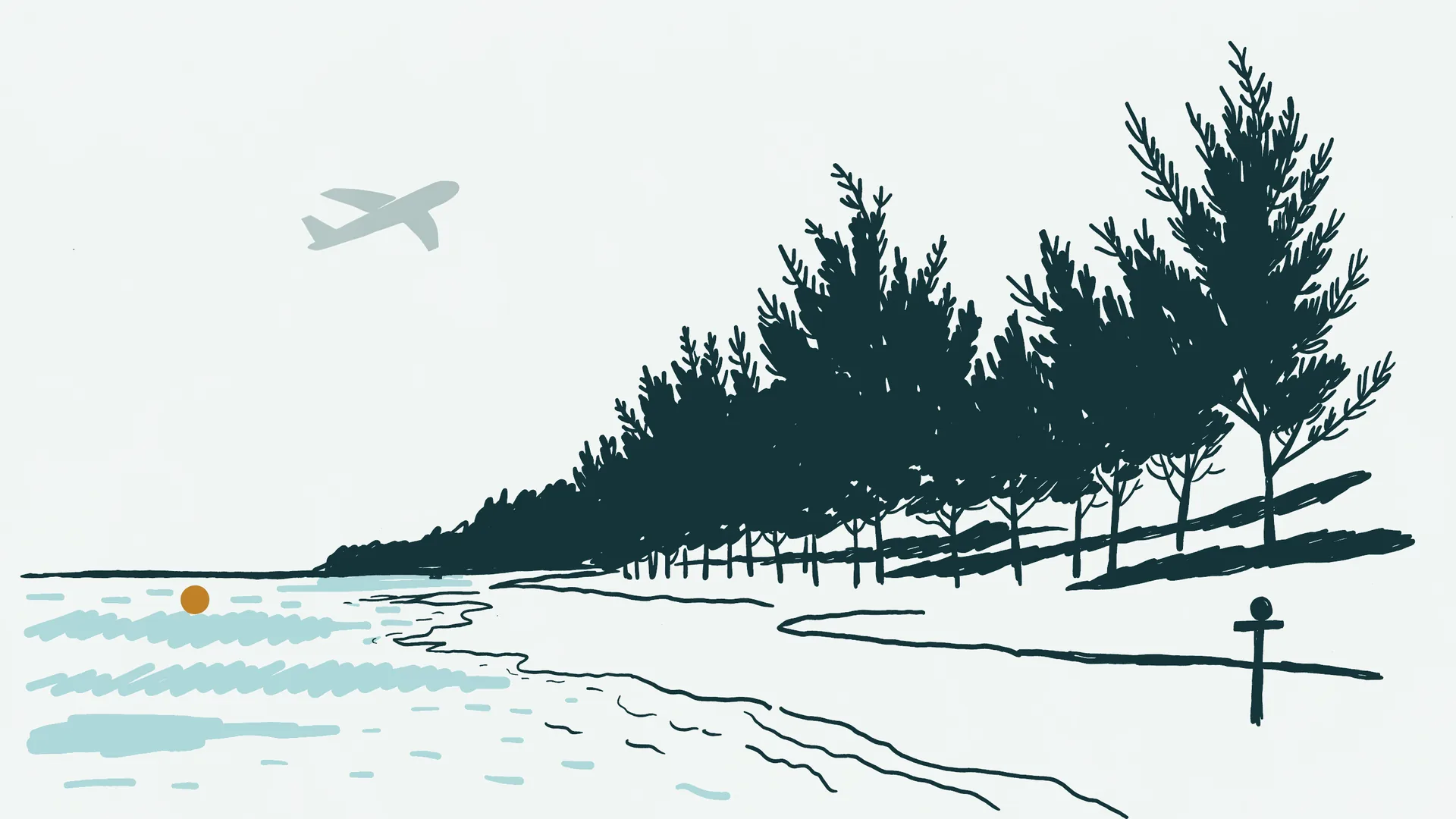

The airport beach: casuarina shade, local seafood and a ten-minute transfer.
- Best for
- quiet · budget · families
- Nearest hospital
- Thalang Hospital (public, 15 min); Bangkok Hospital Phuket, about 40 min
- International schools nearby
- UWC Thailand (Thalang, 20 min)
The lie of the land
Nai Yang is the beach at the end of the runway, and it makes the most of it. The northern end, where aircraft cross the sand a few hundred metres up on their final approach, has become an unlikely attraction; the rest of the bay is a long curve of sand under casuarina trees, with the Sirinat National Park headquarters at one end and a village behind it that is more Thai-Muslim fishing community than resort. The village has a market, a mosque, a few streets of shophouses and a row of beach restaurants where tables sit under the trees.
It suits people with an early flight or a late arrival, families who want a calm, shaded beach, and anyone who wants to spend a few days at the local end of the island. It also suits a certain kind of long-stayer who works at the airport or simply prefers the north. It does not suit nightlife-seekers, and it is a long way from the rest of the island's attractions.
Beach and sea
The beach is about three kilometres long if you count the walk to the runway end, with soft sand, a gentle gradient and shade for most of its length, which is rare on Phuket. In the high season the swimming is easy and the water is clear; a reef offshore at the southern end has snorkelling on calm days, reached by longtail or a long swim. The national-park section is undeveloped, with a few licensed vendors and no beach clubs.
From May to October the bay takes the swell directly and the shore-break can be heavy, with rips at both ends; red flags are common and lifeguard cover is thinner than on the resort beaches. The runway end is fenced and patrolled; you can watch aircraft from the sand but not from directly under the approach lights.
Where to stay
Nai Yang's hotels are a small but varied set. The Slate, on the southern end, is a design hotel built on the site of an old tin mine and the district's best-known address; Phuket Marriott Resort & Spa, Nai Yang Beach and Dewa Phuket are the large four- and five-star properties along the beach road. Behind them, the village has a good stock of guesthouses, small three-star hotels and family-run resorts that trade on the airport proximity.
Villas are inland and on the road towards Nai Thon, mostly mid-market houses in small estates. Condominiums are few; a handful of low-rise buildings serve airport staff and long-stayers. Hostels exist near the village centre and fill with people on early flights.
Eating out
The beach restaurants under the casuarinas are the reason to eat here: seafood by weight, grilled on the sand, at prices set for the Thai families who drive up on weekends rather than for tourists. The village has a morning market and the Thai-Muslim kitchens that this side of the island does well: roti, massaman and rice dishes at breakfast counters.
A small strip of cafés and bars serves the hotels, and that is about the extent of the evening. For anything more, Bang Tao's Boat Avenue is twenty-five minutes south; Phuket Town is a good forty minutes. The airport has its own food, but the village is better and cheaper.
Getting around
Four kilometres from the airport, which means ten minutes by taxi and a fare that is a rounding error compared with anywhere else on the island; some hotels run free shuttles. Grab and Bolt work well here because drivers wait at the airport. The Phuket Smart Bus starts at the airport and runs down the west coast, and the Airport Bus Express runs to Phuket Town.
The village and beach are walkable. For the rest of the island you need wheels: the airport road connects to the main Thepkasattri Road south, and Nai Thon and Mai Khao are ten minutes each way. Scooter rental is available in the village.
Staying a month or longer
Monthly rentals in Nai Yang are modest: apartments and townhouses in the village and along the airport road, a smaller number of mid-market villas inland, and a few owner-let houses on the beach road. The market is priced below Bang Tao and Layan and is mostly occupied by airport and airline staff, teachers at the Thalang schools, and people who want a quiet base in the north.
Long-stayers here are practical: they need the airport, the national-park beach and the local prices, and they are willing to drive for everything else. If a month or more in the north appeals, the form below goes to VillaCarte; say whether you need to be walkable to the beach or would rather have a house inland.
The honest downsides
Aircraft. They are the attraction and the drawback: the northern end of the beach and the hotels nearest the runway hear every take-off, and the schedule runs late into the night in high season. The southern end and the village are quieter but not silent.
It is a long way from everything: an hour to Kata, forty minutes to Phuket Town, and the road south is the island's main artery, busy at rush hour. The evening options are a few bars. The wet-season shore-break is heavy and the lifeguard cover thin. And the national-park character that keeps the beach beautiful also keeps it undeveloped; if you want loungers, beach clubs and a strip, this is the wrong bay.