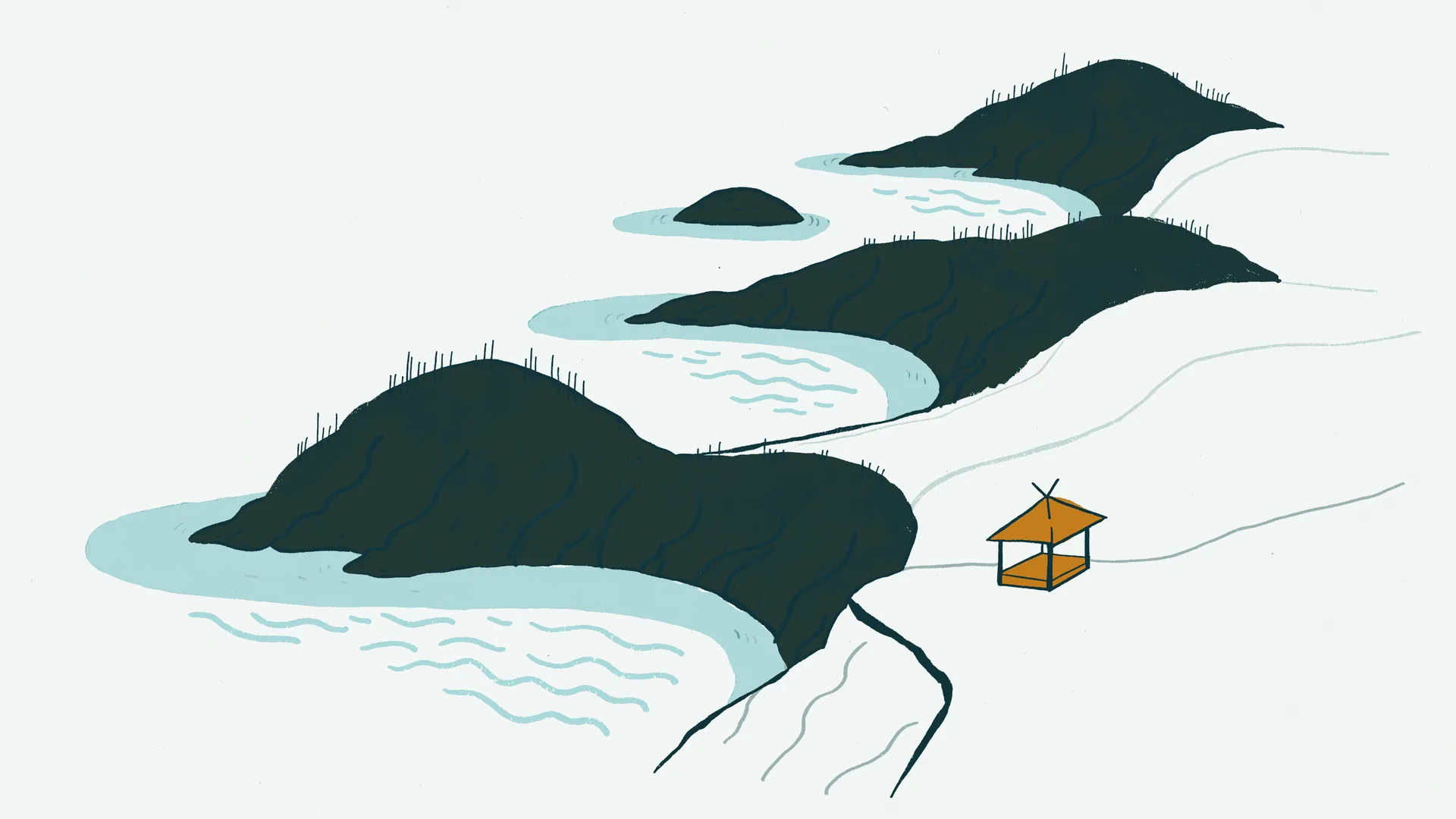

Three kilometres of sand that never fills up, between the two busiest towns on the coast.
- Best for
- families · budget · quiet · long-stay
- Nearest hospital
- Dibuk Hospital (Chao Fa West Road, about 25 min); Bangkok Hospital Phuket, about 40 min; Patong Hospital (public) 15 min over the hill
- International schools nearby
- BCIS Phuket (Chalong, 25 min) · HeadStart International School (Phuket Town side, 30 min)
The lie of the land
Karon is the long, straight beach between Patong and Kata that somehow stays half-empty even in January. The reason is geography: the beach road runs along a strip of casuarina and a lagoon, and most of the hotels are set back across it, so the sand itself has no bars, no clubs and few vendors. The town is small and functional, arranged around the Karon Circle roundabout at the northern end and a second cluster of shops at the southern end where Karon meets Kata.
It is the district for people who want a big beach and an early night: families, older couples, and the German and Scandinavian package market that has been coming for thirty years and shaped the restaurant strip accordingly. It is also a sensible base for a first month on the island, because it is cheaper than Kata, calmer than Patong and fifteen minutes from both.
Beach and sea
The beach is three kilometres of fine, squeaky sand (it makes a sound underfoot, which the tourism board makes much of) with a gradient that steepens noticeably at the shoreline. In the high season the swimming is clean and clear, and the rocks at the southern end towards Kata have snorkelling in calm water. Loungers exist but are spread out; you can always find fifty metres of empty sand.
The steep shore-break is what makes Karon dangerous from May to October. Waves dump close to the beach, the rips run out through the gaps, and the lifeguard flags are red for most of the wet season. The northern end, near the roundabout, is the calmest section in marginal conditions; the middle of the beach is where people get into trouble. Karon has a small surf scene at the northern end in low season, but Kata's break is friendlier for beginners.
Where to stay
Karon is mid-range territory. The big resorts along the beach road, Hilton Phuket Arcadia, Mövenpick Resort & Spa Karon Beach, Centara Grand Beach Resort and Thavorn Palm Beach, are four- and five-star in size and price, mostly in the family-resort mould with large pools and kids' clubs. Le Méridien Phuket Beach Resort has its own cove, Relax Bay, on the road to Patong. Behind them, the streets around Karon Circle and Luang Pho Chuan Road are full of three-star hotels and guesthouses, many of them owned by the same families for decades.
Hostels are few. Villas are on the hillsides, especially the slopes above the southern end towards Kata Noi and above the northern end towards Patong; condominium buildings have gone up on the Patak Road inland side and along the Karon–Chalong road, and these supply most of the monthly rentals.
Eating out
The Karon Temple market, held on the temple grounds near the roundabout on Tuesday and Friday afternoons, is the local food event: grilled seafood, Isaan sausage, fruit and a clothes market. Pad Thai Shop on Patak Road is the roadside stall that food writers keep finding, and it is as good as they say. The strip along Luang Pho Chuan Road and the roads behind the southern end have dozens of Thai restaurants with laminated menus that are nevertheless cooked well.
The German and Scandinavian influence shows in the bakeries and the schnitzel, and Karon has a couple of long-running Italian kitchens. For seafood with a view you go over the hill to Patong's Kalim strip or south to Rawai; Karon itself keeps things on the plain side.
Getting around
Forty kilometres from the airport means about an hour and ten minutes by the west-coast route, or a little longer if the driver goes through Phuket Town. Grab and Bolt are reliable; the Phuket Smart Bus stops along the beach road on its way from the airport to Rawai; songthaews to Phuket Town leave from the roundabout. Karon is flat along the beach road and easy on foot or by bicycle, but everything inland is uphill.
Scooters are the standard way to reach Kata (ten minutes) and Patong (fifteen minutes over the hill, which is steep and heavily used by minibuses). The Patak Road route to Chalong and Phuket Town avoids the hills and is the sensible road if you rent a car.
Staying a month or longer
Karon's monthly market is condominiums first, villas second. The condo buildings on Patak Road and the Karon–Chalong road are a few minutes' ride from the beach and are where most furnished one- and two-bedroom rentals come from; older apartment blocks near the roundabout are cheaper and closer to the sand. Villas with pools sit on the hills at both ends of the beach and on the road to Chalong.
The long-stay crowd is a mix of European retirees who came on package holidays for years and then stayed, families who want a big beach without Patong, and some remote workers who prefer the quiet. If you are looking at a month or more, the form below reaches VillaCarte; tell them whether you need to be walkable to the beach or would rather have a pool and a car, because the two markets barely overlap.
The honest downsides
The shore-break in low season is genuinely hazardous, and Karon has more drownings than its calm reputation suggests. There is no swimming on red-flag days, full stop. The town has little character of its own; it is a service strip between two more interesting places, and the evening options are restaurants and a few bars.
The beach road is a long walk if your hotel is at the wrong end, and the inland hotels involve crossing a busy road to reach the sand. The lagoon behind the beach breeds mosquitoes in the wet season. And while Karon is quieter than Patong, it is not quiet in the way the east coast or the north is quiet; the tour buses still come.