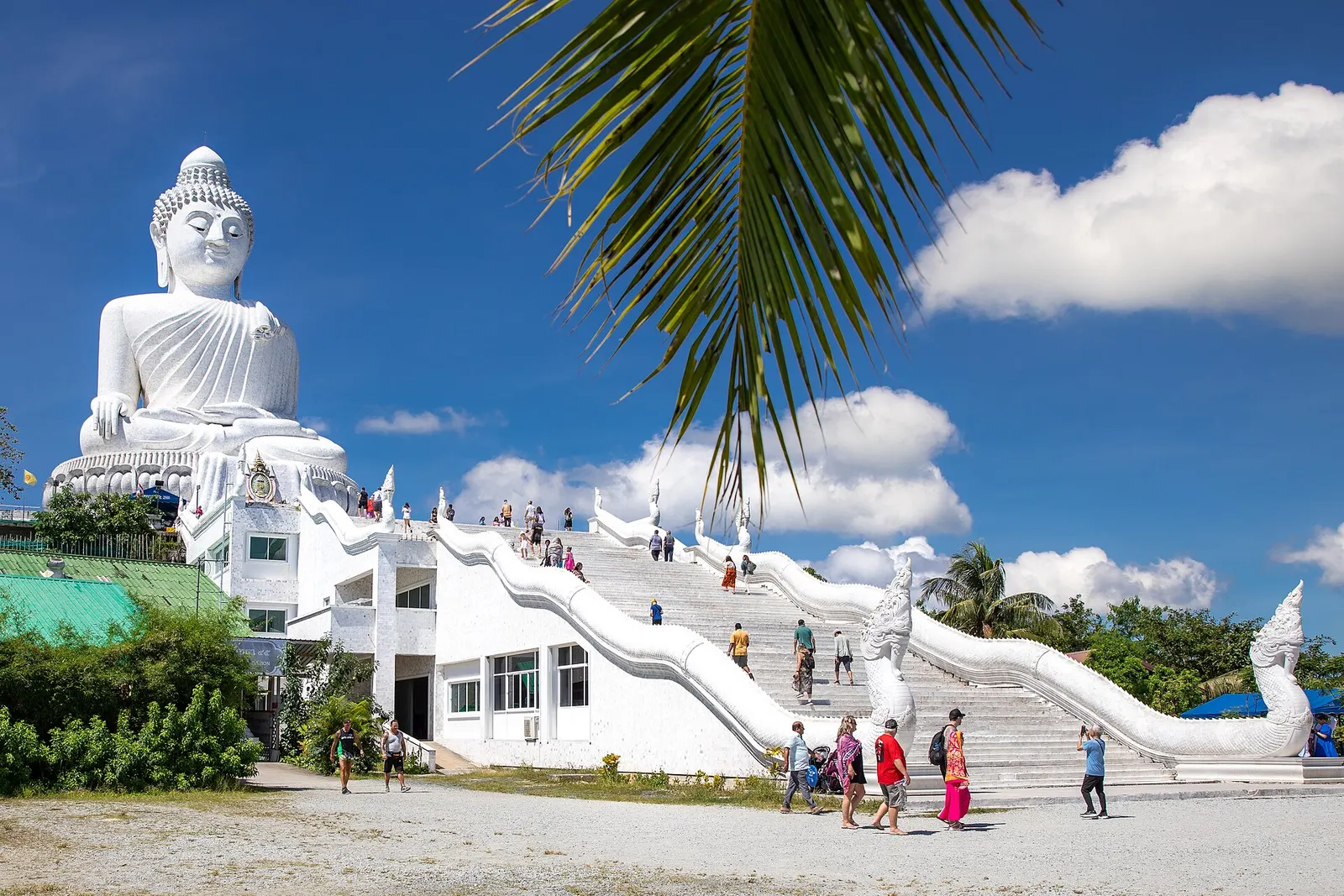
Marina, Big Buddha and Muay Thai gyms; the practical base with the cheapest monthly rents.
Best for
long-stay · budget · digital-nomads · families
Nearest hospital
Dibuk Hospital (Chao Fa West Road, 10–15 min); Bangkok Hospital Phuket, about 20 min
International schools nearby
BCIS Phuket (in Chalong) · HeadStart International School (Chao Fa West Road, 15 min) · British International School Phuket (Koh Kaew, 30 min)
The lie of the land
Chalong is the working south of the island: the bay where the dive boats and the Phi Phi speedboats leave from a long concrete pier, the hill with the Big Buddha on top of it, the temple Wat Chalong that Thai visitors treat as the island's most important, and the roads around them lined with gyms, schools, mechanics, supermarkets and the housing estates that most of the south's residents live in. There is no beach to speak of, no strip and no resort district. It is where things get done.
It suits long-stayers who want the lowest monthly rents on the island within reach of the beaches, divers and boat people who want to be next to the pier, Muay Thai trainees at Tiger Muay Thai and the other camps on Soi Ta-iad, and families who want a school within five minutes. It suits short-stay tourists poorly, unless they have a dive course booked.
Beach and sea
Chalong Bay faces east and is shallow, muddy at low tide and busy with moored yachts and longtails; nobody swims here. The pier is the point: it is the departure point for the majority of Phuket's dive trips, snorkelling tours and speedboats to Racha, Koh Hae and Phi Phi, and the Ao Chalong Yacht Club and a cluster of dive shops occupy the road behind it. Palai Beach, on the bay's northern shore, is a local picnic beach rather than a swimming beach.
For swimming, Kata is fifteen minutes west over the hill and Nai Harn twenty minutes south. The east-facing bay is sheltered from the south-west monsoon, which is why the boats are here, and in the wet season it is often calm while the west coast is flagged; but calm is not the same as clean, and the bay is not a place to get in the water.
Where to stay
Hotels are thin and mostly small: guesthouses near the pier for divers, a few mid-range hotels along Chao Fa Road, and the gym-affiliated accommodation on Soi Ta-iad, where a room with a bed and a fan is the standard for fighters on a training visa. There is no five-star property in Chalong and no beach resort.
Housing is the story. Chalong has the island's largest stock of ordinary houses and townhouses in estates off Chao Fa East and West Roads and on the slopes towards the Big Buddha, plus a growing number of condominium buildings along Chao Fa West and near the Chalong junction. Villas with pools exist on the hills and towards Kata and Rawai; they are cheaper than their west-coast equivalents because there is no sea view.
Eating out
Kan Eang@Pier, the seafood restaurant beside the Chalong pier, has been the district's special-occasion table for decades, and the road behind the pier has smaller seafood places with tanks. Soi Ta-iad, the gym street, is the south's health-food strip: protein bowls, smoothies, grilled chicken and rice at every second shop, priced for fighters. The Chalong junction and Chao Fa Road have Thai street food, Isaan grills and the markets that feed the residents.
Chalong Bay Rum, the small distillery off the Chao Fa road, does tours and a bar. For a wider choice, Rawai's seafood market is ten minutes south and Phuket Town's Old Town twenty minutes north on a good day.
Getting around
Chalong is thirty-eight kilometres from the airport, about an hour by the bypass road through Phuket Town. Grab and Bolt work well; songthaews to Phuket Town leave from the main road; the Phuket Smart Bus does not come here. The district is flat and the estates are quiet enough for cycling, but the main roads are fast and have no pavements.
The Chalong junction, where the five roads of the south meet, is the island's most notorious bottleneck; the underpass eased it but did not cure it, and rush hour towards Phuket Town or Kata still queues. Most residents have a scooter or a car and time their trips around it.
Staying a month or longer
The monthly market here is the island's cheapest per square metre and its most practical: two- and three-bedroom houses in gated estates, townhouses, and condominiums along Chao Fa West Road, mostly unfurnished or lightly furnished and rented by the month or year to residents rather than to tourists. Pool villas on the Big Buddha slopes and towards Kata are the mid-market option with a hill view instead of a sea view.
Who lives here: families with children at BCIS, which is inside the district, or at HeadStart a few minutes north; dive instructors and boat crews; fighters at the camps; and remote workers who would rather spend on a bigger house than on a beach address. If a month or longer in the south appeals, the form below goes to VillaCarte; say whether furnished matters and how far from the pier you want to be.
The honest downsides
Traffic is the daily cost: the Chalong junction and the Chao Fa roads carry all of the south's movement to Phuket Town and the airport, and the school run and the evening rush queue for a long time. There is no beach, and the bay is not for swimming. The district is spread out, hot and short of shade, with fast roads and few pavements.
It is not scenic: the estates are estates, and the strip on Chao Fa Road is car dealerships and hardware. Flooding after heavy rain is a regular event on the low-lying roads near the bay. For anyone who came to Phuket for the sea, Chalong is a compromise; it is a good one only if the rent difference or the school buys you something you value.
Buying in Chalong: Layan Real Estate
17 projects in Chalong in the Layan Real Estate catalogue on September 5, 2026: district medians, three entry points and the tour that shows them.
$2,445
Median price per m² · n = 17
$561,637
Median entry price · n = 17
6%
Declared yield, median · developer projections · n = 14
La Vista Villasvilla · ready · VillaCarte Groupfrom $1,254,165 · ~6%
Fantasea Chalongcondo-hotel · under construction · Fantasea Plusfrom $84,530
Aceller Hotel & Residencecondo-hotel · under construction · Aceller Property (Aceller Groups)from $89,816 · ~6%
Island-wide medians 2015–2025: bar and number = rain in mm, mark = west-coast sea state, top line = climate season.
37
○
Jan
21
○
Feb
73
○
Mar
183
○
Apr
343
◐
May
275
◐
Jun
241
●
Jul
270
●
Aug
309
●
Sep
340
○
Oct
270
○
Nov
113
○
Dec
bar: median rain, mm○ calm · ◐ some swell · ● roughHigh season: Nov–Mar · Shoulder: Apr, Oct · Green season: May–Sep
Source: Open-Meteo (ERA5), 2015–2026. One reanalysis point for the island, so the strip is the same on every area page; the west coast takes the monsoon swell, the east and south coasts do not. Full month-by-month data →
Estimate a Phuket trip
Pick an area, nights, travellers and budget class — the estimate uses the index medians for that area.
Estimated total
$1,050
Stay · Rooms 1
$441
Food and days out
$490
Airport transfers
$0
One day tour per traveller
$119
Default parameters, rendered at build time so it works without JavaScript: Chalong, 7 nights, 2 travellers, Mid-range. Medians as of October 2026
Estimates use medians from the index; your booking will differ by dates, property and season.
Frequently asked questions
How much does a 4-star hotel in Chalong cost per night?
As of October 2026, the median 4-star hotel night in Chalong is $63 per night (n = 24, high season, range $53–$88). The observation is taken for a travel date 30 days ahead; 3-star and 5-star medians are in the price table on this page.
What does a 3-bedroom villa in Chalong cost per month?
As of October 2026, the median 3-bedroom villa in Chalong is $5,205 per month (n = 20, high season, range $3,150–$5,608). Monthly rentals from one month upward are handled by VillaCarte, a Phuket agency; the enquiry form is on this page.
How far is Chalong from Phuket airport, and what does a taxi cost?
Chalong is 38 km from Phuket International Airport. No median for the metered-taxi fare from the airport in Chalong is published yet: a figure appears only once a segment has at least 5 observations, and this one has not reached that in the current revision (October 2026). Minivan and ride-hailing medians are in the transfers table.
How much do I need per day in Chalong?
As of September 2026, the median mid-range daily budget in Chalong is $35 per day (n = 8, all year season, range $24–$50). The daily budget covers meals, local transport and one activity, and is published at three levels: street-food, mid-range and fine-dining.
What is Chalong like?
Marina and Big Buddha hill; the practical base for dive trips and the cheapest monthly rentals. Location: East coast, 38 km from the airport.
Which areas are next to Chalong?
Rawai, Kata, Phuket Town, Panwa. The price table on this page shows Chalong against these neighbours, so a cheaper night or month a few kilometres away is visible at a glance.
Can I rent in Chalong for a month or longer?
Yes. Monthly villa and apartment rentals in Chalong are arranged through VillaCarte, a licensed Phuket agency; send the area, budget and dates through the form on this page and they reply the same day. The index figures are independent of these enquiries.
Staying a month or longer? Monthly villa and apartment rentals are handled by VillaCarte, a Phuket agency. Tell them the area, budget and dates — they reply the same day.